
Endovascular Robots - Have you worked it out yet or not?

I'm still a little perplexed by the number of people that are still ramming money - resources and efforts into multiarm lapraoscopic robotic systems to try and run head on with INTUITIVE. Today another four multiarms popped up out of China. I don't want to say the market is saturated - but there are way too many companies chasing a market this owned by one behemoth.
On the other hand there are millions of people dying needlessly - and millions more being mamed through stroke. Many of them - a reletaively (in neurovacular terms) simple mechanical thrombectomy - as soon as possible - could be the life changing moment. As I've said in my full blog here - https://www.howtostartupinmedtech.com/post/neurovascular-robotics-heads-to-the-brain
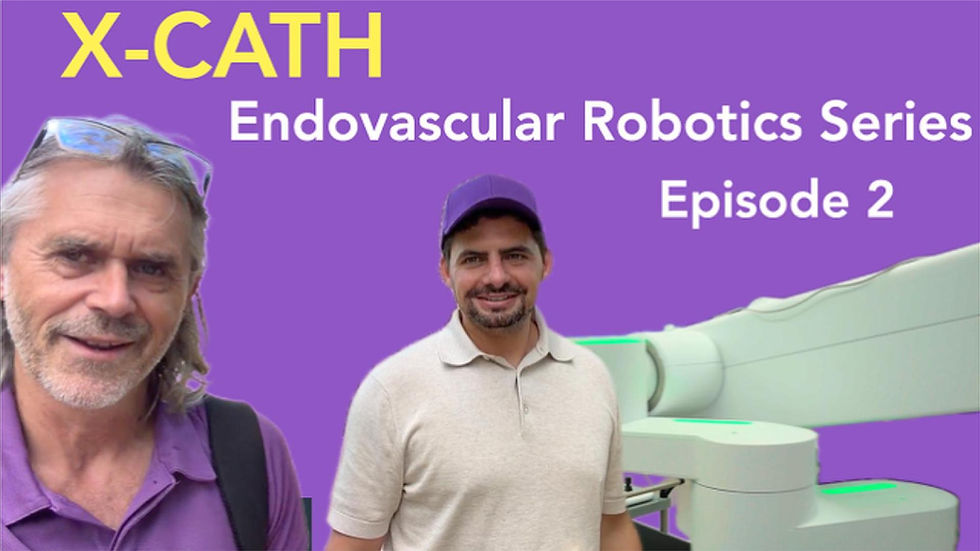
I've said clearly - this is "big" - "meaningful" - "important" yet my videos on Ottava get 4 X views compared to any videos on neurovascular robots. So I'm going on with my series at full power and just dropped this video that talks about XCath - a company that completed the world's first telerobotic stroke thrombectomy via a robot. YES they have actually already done it. It's real.
Dive into this video (Episode 2) and take a look at the technology and team behind IRIS from XCath.
Now... for any clinicians out there - if you are in the neurovascular space - or endovascular space in general - this area is about to change. Primarily for massive patient gains - but also for your perosnal gains. Being able to sit at a console and drive a robot out of the reach of radiation. Able to time wearing lead. Able to be more ergonomic - are all good reasons for you. Being able to do stroke at a distance and save transfer time of patients is where time is brain. Is a game changer for your patients.
For payers - It's not even gonna be close - money spent vs costs saved long term. We are talking a % of GDP on stroke care. For investorss and analysts. Go deep here - put away your biases of five years ago and think about if this is an area worthy of support and investment. And remember - "who own this railroad eventually decides the rolling stock that runs on it" !!!!
For Industry - the entire space of endovadscular is about to be up ended. It's veen a long time - but "WHY NOW?" - because there is a confluence of lack of staff (wait 5 years) - growing patient population in the need for care age group (wait 5 years) - and a confluence of AI, connectivity and robotics... plus new technolgies that make this real and now. We are about to see a revolution in the field of neuro. But as covered in my last video - Episode 1 - we will also see it in peripheral vascular - and a rebirth in cardiovascular / endocardiac.
My recent visit to Sentante was full of surpirses for me in peripheral vascular applications.
I know we all hark back to "Well Corindus was a flop and Robocath didn't fair much better" - but there were reasons for that; and the patient advantages never felt enough - and it was introduced at a time when clinciian benefits were not such a compelling thing. I can assure you Corindus II with Siemens; and Robocath II with Stereotaxis are different beasts. Things have changed and are changing fast.

I had the pleasure to talk with Philippe Bencteux from Robocath and David Fischel CEO Stereotaxis: and that video is in the works. And I'm taking a trip to see Matt Curran and the team at Nanoflex to show what they are all up to. Then a host of other videos one after another with as many of the companies as possible. Because NOW is the moment for this. Now is the time when AI and autonomy will race into endovascular procedures and to change the face of endovascular interventions. Teams are collecting data and working with NVIDIA foundation models to drive towards autonomy at speed. But have you worked this out yet? Or are you still thinking about mutli arm robotic systems in laparoscopy? I hope I can give you some deeper inspiration to look into this game changing world. If we can crack some of these challenges in endovascular procedures we move the dial in healthcare. The change in endovascular is happening right now - as we speak. And this is going to happen faster than most people beleive. Thanks to the kind sponsorship of Cambridge Design Partnership to make this work possible and help get this message out there.

These are the opinions of the author for educational purposes only. All trademarks owned by their repsective companies.

