
So is Histosonics’ Edison a surgical robot?
- Steve Bell

- Oct 30, 2025
- 6 min read
Updated: Apr 22

T
his might seem like an odd question on the face of it - but then again I’m odd.It’s definitely NOT a da Vinci - right? But in many aspects - it sort of fits into a surgical robot category (and I’ll explain why a bit later.)
Let me start with what is Histosonics and Edison and what it is… let me start with a simple overview:
Edison is a new kind of surgical system that can destroy unwanted tissue inside the body without any incision, heat, or radiation. It uses precisely focused sound waves to create tiny bubbles that break apart targeted cells, while leaving surrounding tissue unharmed. The whole process is guided by real-time imaging and a robotic arm that keeps everything perfectly aimed. In simple terms, Edison performs surgery without touching the patient - using sound instead of scalpels.
(And note well the no heat or radiation!)
“But is that really a surgical robot then?”
Erm yes and no. and yes… it’s defiantly a robot and let me break it down why it sort of fits as an incision less surgical robot of sorts.
Is it a surgical robot?
Robotic Positioning System
It has a mechanised arm that holds and orients the ultrasound transducer array with millimetre precision.That arm is controlled via software and image feedback (you could say) like a da Vinci arm follows a camera feed, Edison follows its ultrasound view.
Image-Guided Automation
It builds a 3D model of the target organ using ultrasound and planning software.The clinician defines the treatment volume, and the robot autonomously moves the transducer to deliver cavitation pulses to every voxel (Volumetric pixel - or a 3D pixel) in that zone.It’s effectively robot-assisted targeting, not hand-held guesswork.
Closed-Loop Feedback
During treatment, the system detects cavitation in real-time and adjusts position and / or energy accordingly.That’s the hallmark of robotic control: sensor-driven, automated feedback loops maintaining precision without manual correction.
No Tools, No Ports, No Cuts
Traditional surgical robots enhance human dexterity inside the body.HistoSonics replaces that paradigm entirely it projects mechanical action through tissue.In that sense, it’s closer to a “non-contact surgical robot” or robotic energy field generator than a manipulator.
Regulatory and Functional Positioning
In FDA filings, it’s typically classified under robotic image-guided therapeutic ultrasound.So weirdly, yes, in regulatory and functional terms, it’s considered a robotic surgical system, though it performs “surgery by clever physics,” not by instruments.
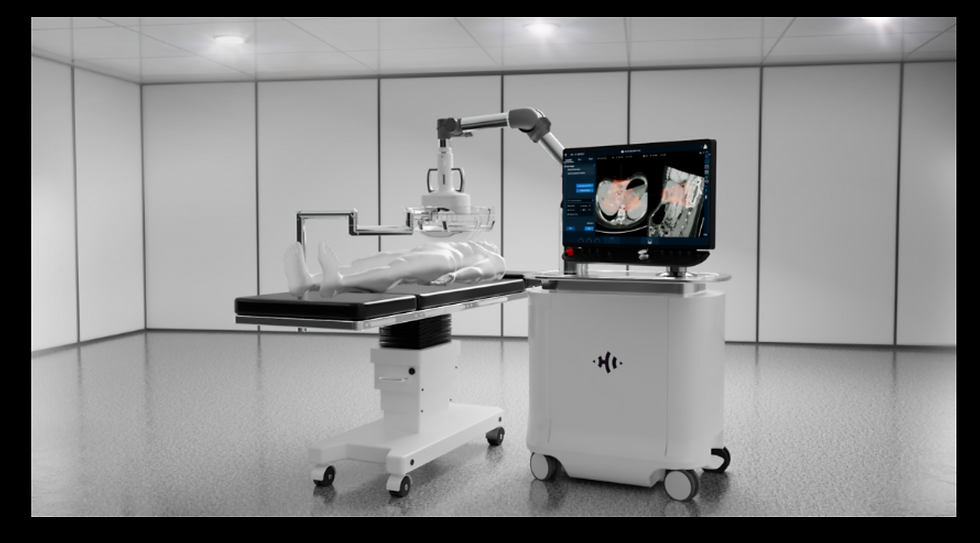
So let me break this down a bit for you as it is super clever. And yes, this is why is is garnering such hype and investments.
HistoSonics recently secured massive and very high profile financial backing from several heavyweight investors, reflecting strong confidence in its Edison platform and non-invasive histotripsy technology. The company raised $102 million in its latest Series D round, led by Alpha Wave Ventures, with participation from Johnson & Johnson Innovation, HealthQuest Capital, and Amzak Health. Earlier rounds had already attracted strategic investment from Varian Medical Systems and long-term support from Venture Investors and Lumira Ventures.
To me, this list of backers signals a clear endorsement from both major device manufacturers and growth-stage med-tech funds. Importantly…Varian’s involvement connects HistoSonics to the oncology and radiotherapy domain, while J&J’s ongoing investment shows alignment with their broader surgical robotics ambitions. The presence of large institutional investors such as Alpha Wave and HealthQuest underscores confidence that histotripsy is not just an interesting technology but a scalable surgical platform.
Watch for others looking at this area - there is a lot of academic research in this area and a few stealth companies I can’t reveal today.
In short, HistoSonics is now positioned as one of the most well-funded players in the emerging field of non-invasive robotic surgery, backed by investors who understand both the clinical and commercial implications of shifting surgery from cutting and burning to controlled, image-guided mechanical precision.
With their future ambition in urology - I would not be surprised if Intuitive were not keeping a very close eye on them.
So what’s all the Hype about HIFU?
Oh but Steve… HIFU has been around for ever - this is just a fancy bandwagon on the back of robotics.. right?
Er.. no - this is surprisingly new - even if it sounds old technology: and even I was wondering for a while why this was different to what I’ve seen over the years.

HistoSonics’ Edison system represents a completely different class of focused ultrasound technology. Most of the field revolves generating around heat to destroy tissues - high-intensity focused ultrasound (HIFU), radiofrequency ablation, or cryoablation. Instead, HistoSonics uses none of these. Its approach, called histotripsy, is purely mechanical. Instead of cooking, burning or freezing tissue, it literally tears it apart at the cellular level using focused sound energy. Boom!
How It Works
The Edison system uses an array of focused ultrasound transducers that send very short, high-amplitude pulses of sound energy to a precise 3D focal point inside the body. At that point, the pressure becomes so extreme that water molecules within the tissue are pulled apart, forming a cloud of microbubbles. These bubbles rapidly expand and collapse, generating mechanical shear forces that liquefy the targeted tissue. Surrounding structures, just millimetres away, remain untouched.
It’s actually pretty bonkers. But so cool to see on the demo - and I had one at last year’s SRS - and well. I was convinced. It is pretty amazing to watch the energy literally carve out a small pocked within the liver - and I can assure you it is liquified.
This insane process is known as cavitation. It is purely mechanical and non-thermal; meaning no heat is generated, no burns occur, and no scarring results. The treated tissue is then safely absorbed by the body over time.
Let me explain that as a lot of people may well be saying “But doesn’t that just bubble up cancer and spread it everywhere?”
No this literately destroys the cells at a sub cellular level - tearing apart any capability of the cancer to replicate and spread. It literally becomes liquid mush that the body absorbs.

Precision and Control
Edison integrates real-time ultrasound imaging and robotic positioning. The robotic arm continuously adjusts to compensate for organ movement, such as respiration, ensuring that the cavitation zone stays precisely on target. Clinicians can actually see the cavitation cloud forming during treatment, providing immediate feedback. Parameters such as focus depth, energy, and coverage area are software-defined, making the system adaptable and potentially fully automatable ( is that even a word?) in future versions.
Why It’s Different from HIFU and Other Ablation Techniques
Feature | Histotripsy (HistoSonics) | HIFU / RFA | Cryoablation |
Mechanism | Mechanical cavitation (bubble collapse) | Thermal (heat) | Thermal (freeze) |
Temperature | Non-thermal | 60–100 °C | -100 °C |
Precision | Millimetre-level targeting | Limited by heat diffusion | Dependent on Ice ball formation |
Collateral Damage | Minimal | Risk of charring and scarring | Minimal |
Real-Time Feedback | Immediate via cavitation imaging | Often delayed | Ice ball can be seen on Ultrasound / CT |
Pain and Recovery | Typically none; no incision | Requires anesthesia; tissue burn | Minimal pain - fast recovery |
** Table corrected to position Cryoablation correctly
This could be big.. nah it is big
I’m pretty stoked on this (as are the big investors) because I think HistoSonics represents a new paradigm for surgery to rather non surgery. Well it is surgery just no incisions at all. It’s robotic, image-guided, and completely incisionless. It shows that tissue can be selectively destroyed using “physics” alone, without the normal heat, chemicals, or cutting (yes of course that is physics too but you know what I mean right.) This opens up a future where precise, AI-driven targeting could replace traditional surgical resection for many soft-tissue diseases.
Get the disease early (oh I’m back to that again…) and liquify it.
In short, HistoSonics is not another thermal ablation company. It is redefining what it means to perform surgery; moving from burning and cutting to controlled, mechanical destruction guided by sound and robotics.
What are the current indications?
Here’s what the Edison system by HistoSonics can do today, and what’s coming down the pipeline.
What it’s approved for
The Edison system has FDA clearance in the U.S. for the non-invasive mechanical destruction of liver tumours, including un-resectable liver tumours.
The indication states it uses a non-thermal, mechanical process of focused ultrasound (histotripsy) to destroy liver tumour tissue.
Important caveats: The FDA clearance emphasises that the device has not been evaluated for outcomes such as 5-year survival or local tumour progression. (So claims are still a little limited.)
What’s in trials / coming next
There is a major trial named #HOPE4KIDNEY for kidney tumours: The system is investigational for kidneys, not yet FDA cleared for that indication.
Another trial: GANNON Trial for pancreatic tumours (un-resectable locally advanced/oligometastatic).
There is also intent to expand into other organs (they mention prostate, brain etc.) though those are earlier stage.
But… and it’s a big but. If it can start to expand into other areas beyond the liver, and it does get those bigger claims… then who the hell would want a first line incision operation if you cold go histotripsy. If (and it’s still a big if) this technology does what it says on the tin… then we could see impacts on surgery and other robotic systems. Classic robotic surgery systems.
These are just musings by the author for educational purposes only.


