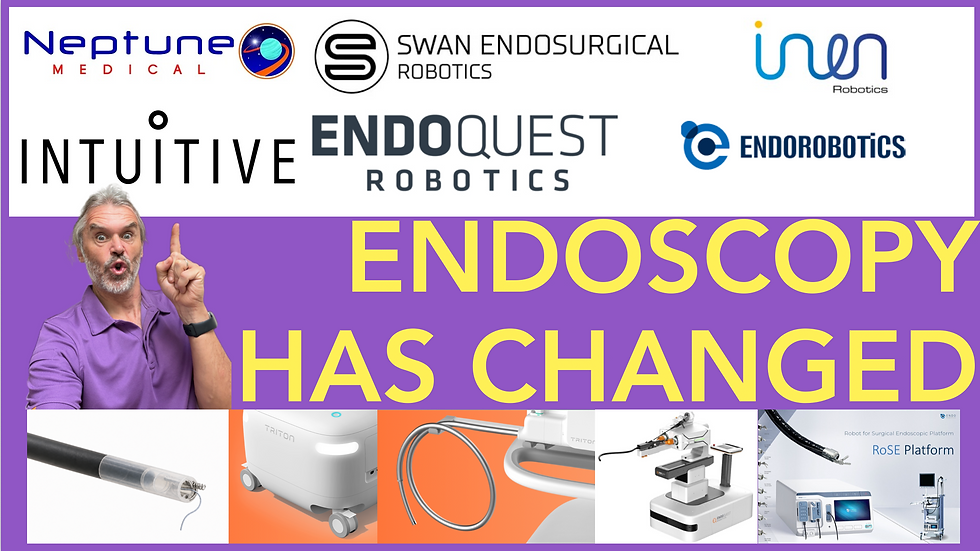
Four Platforms every surgical robotics company will need


Segmentation is already here. And if you think the world is all about the da Vinci Xi and that’s it - then you’re not keeping you eyes on what’s happening.
In my opinion for every major strategic company there will be a need for 4 distinct platform types - and Intuitive has three of them already. Read below what the platforms are and what they mean for surgical robotics companies.
—-
Building an Ecosystem
Unless you are not really paying attention, you will have seen the words “Ecosystem” splashed across Intuitive communications. It’s something that Apple uses all the time. And there are parallels.
You see a lot of people read that as their “hardware and software” as an ecosystem. But the truth is it is much much wider than that. And it is where you need to understand better:
Ecosystem is subtle. Let me give one example - if you use the da Vinci console - the head in the system, the pinch controllers, the foot pedals etc… that is part of their ecosystem. It is a user experience that you get “familiar with.” Icons, menu items, log ins, setting changes.
All subtle things that you get “comfortable with.”
So a smart company (like Apple) will have that look and feel across products. So if you drive an Xi or an SP - that user interface all feels “familiar”. And that is part of the lock in to that ecosystem.

And that is not just for the surgical users. Things as benign as “contracts” can be a familiar and easy way to lock purchasing teams into your ecosystem. A finance department can read an Intuitive contract for an Xi as easily as an SP. Much of the “boiler plate language” will be the same. They will feel assured by the T&Cs because they are the same for that company. That is ecosystem.
Invoicing becomes easy - if you need to pay for Xi consumables and SP consumables - then its all in the same billing system; maybe even in the same order - that’s easy.
Servicing - you can have one point of contact as a service team - with one number - one service T&Cs - etc etc. That is ecosystem.
Sterilisation services, data agreements, connectivity, inventory management, dashboards in software. All part of an ecosystem that makes it frictionless to do “more” business with the company.
This ecosystem means that if you wanted to change provider you have to span across more and more and more users, stakeholders. More departments, more contracts have to change, more service agreements - and on and on. People have to get new systems and new interfaces. It’s all ecosystem.
It’s why I use iPhone and a Mac and and Apple TV - ecosystem. They all cross talk. I have one Apple account - software across them is close enough to know how to use them all. It’s easy - convenient. Changing to anything else for me is more pain than it’s worth.
All of it is ecosystem - but at the core of it are the products. Xi, SP, Ion … and more to come.
You’ll see that Google based devices - to be competitive with Apple - need a watch, a phone, a TV system, a computer, an iPad equivalent etc etc. To be competitive with the leader you need to be able to match them 1 for 1. And have all those products feel familiar and talk to each other.
Let’s Talk Platforms
I won’t deep dive this now by what I fundamentally mean by platforms, parts bins, component sharing etc - maybe that is for another post one day.
Let me talk gross platforms that define the products Intuitive has. Like Xi, SP, Ion.
We are talking here about Surgical Robotics - and mainly I’ll discuss about abdominal and thoracic usage as the main premise. Vascular, cardiac (endo Cardiac) is not in my platform description here. That is slightly different.
But if we are talking about a company being in the abdomen / Thoracic space (and of course I include abdominal wall) - then there will be four main platforms that any company that wishes to compete MUST have. And I’ll explain why stand alone’s will struggle (IMHO).
Platform 1: Multiarm / Multiport “lap - Thoracic” robot
Platform 2: Single port “Lap - Thoracic” robot
Platform 3: Flexible single channel small diameter robot (Bronchial - Urological)
Platform 4: Flexible endosurgical robot (multichannel for GI)
Although is could be tempting to think - “well isn’t this just overlap?” - we need to understand that each of these platforms has subtleties in form, function, user and purpose.
And we also have to start to think 5 years from now for concomitant - rendezvous procedures and new therapy modalities. You can read all my other posts on this.
You need a multiarm (Multiport) robot - or equivalent that can allow the user and hospital to perform the majority of laparoscopic and thorascopic procedures - (be that fully robotically or lap 2:0)
This is the work horse with over 10,000 installed and used daily. It is the foundation platform for any company to be present in a market if they wish to compete with Intuitive. It is what forms the “core” of the platform offering.

Single port is not a flexible endosurgical system. It may share many of the common principles - but technically it is a different system. SP is growing in use - slowly - but growing - and as the Intuitive SP becomes more capable (energy, stapling, vision, instruments) more procedures can be done via a single minimal incision. A whole host of SP procedures will start to make more sense vs multiport. The procedures will segment.

These are two very important linked platforms. They share common users - common areas of surgery and importantly common ecosystem components from console design, to tower, to energy, to software to data systems. A user can easily flick between both and feel that cohesive (if not identical) feel to the system. And they can compare and contrast data even.
We are seeing the growth in the first “battle field” of single channel flexible robotic systems - with ION. Already here - today - we see a slight divergence of users - and control components etc - but you have to look deeper than that. Xi, SP are thoracic products - ION today is thoracic. The next push is endourology - and Xi, SP do urology. The user convergence is starting to happen.
And these systems are starting to use shared underpinnings. Plus some of the navigation technology is going to start to spill across - it’s just time. But especially with AI and autonomy. Navigation will start to blur the lines.

Menus feel similar “Intuitive-esque,” service, contracts, my Intuitive - are all hooked up already.
We see (depending on the health system) even the same users - and for those users of the ION and the Xi - it all feels “sort of familiar”. Buttons have the same feel - plastics are the same - drapes - menus - spfytware flow. The same will clearly happen in urology.
And then the final frontier will be endoluminal surgical robotics. A one step up in diameter and capability from the small bore single channel - with multiple channels - extended vision and micro wristed flexible instruments that will feel like… well like the longer SP instruments.
And be assured when it comes… it will have the same console, the same tower (of sorts) the same look and feel to software - and more and more the same user interface. It will allows a merging of “users” with heir current customers being in the real driving seat.

(I really do need to do that blog about the convergence of users and how this will be part of that style of NOSCAR thinking of the merging of surgery and endoscopy.)
I will eat my hat of this doesn’t look and feel like a long SP to the users - despite being technological quite different challenges.
So with that you will have 4 platforms that can cope with pretty much anything from diagnostics - to see n treat - to natural orifice procedures early in the disease state - to single port procedures for smaller anatomical areas or retroperitoneal approaches to full on abdominal and thoracic multiport approaches for the “big stuff.”
And today Intuitive has 3 or those four elements on market. With I’m sure number 4 in development.
But it’s not just Intuitive… right…
We can already see that multiple strategics and smaller independent companies are already well down this path. And I mean well down this path. You just had to walk the floor at SRS 2025 (society of robotic surgery) and you could go and drive many of these platforms. And you could drive up to three of them on single booths.
Microport Medbot has the Toumai, Toumai single port and a bronchial robot with a flexible catheter. Edge medical - Multiport - Single Port - and Bronchial flexible robot Johnson & Johnson - Monarch, Monarch Urological 3 arm, Ottava… And the list goes on.
What all companies must understand is that all of the major robotic companies that will survive in this space will have these four platforms. (Or access to them.) And to be “competitive” they will need all four platforms… right?
Let me take a pause here. Now I’m not saying that if a company only has one platform it cannot sell that platform and have a base of users. Of course it can. I’m talking 30,000 ft strategic here and longevity and market presence. Significant market presence.
Certain hospitals may well want just (and can only afford) a single platform. Such as a Multiport, or a single port. It will depend on size, budget, specialty, state of the healthcare system.
What I’m talking about here is a company that wants to be a “bigger” player. Or any company that (especially across bigger health systems) want to compete with Intuitive. And any company that wants to be competitive in the major developed and high profit markets across the world.
Let me be clear - if a Hospital; has 12 daVinci Xis, 4 da Vinci SPs, 5 ION for lung or urology, 6 ION for endossurgical — and you as a company are selling 1 of your robots as an alternative… you are not competing, you are a research project for writing clinical papers or appeasing one of your opinion leaders in that hospital. It’s a rounding error.
If you wish to be competitive as a company you will need to be able to offer up these four platforms - and have all four platforms talk to each other, feel like each other, have shared parts and part bins. Shared service teams, deliver, contracting, billing - etc etc.
I hope this is clear as I want to distinguish between “ability to sell” and being “competitive.”
Contracting, training, familiarity
We are talking here about a decade long play. And in the next decade several things will start to happen. Firstly contracting will start to look for preferred suppliers that can sell across a range. Ensure data crosses the platforms, and that data can drive efficiencies and savings. The contracts will want to make sure that servicing is a complete service across platforms - leveraged to reduce financial impacts. Supplies, contracts, payments, T&Cs etc are homogenous by one supplier. It will make life easier and efficiencies bigger. “But people want to break these monopolies” - it won’t be a monopoly. As you can choose between 6 full line, different suppliers. But they will choose one of the suppliers as a partner as institutions will want choice, but not fragmentation.
If you look to a deeper form of contracting across the globe - it will be tenders. Today tenders are often single robots for a specific department (more so a few departments.) But as we see more regional and national tenders emerge they are morphing into major supply agreements for the next 7 to 10 years. And often multiple suppliers. And if you are not on… you cannot sell. And in some countries this will be meaningful amounts of public procurement.
I foresee that these tenders will be shaped to include the four platforms as part of a tender across service. Shaped by the companies that have all four platforms and want to help nudge small single providers to the sidelines.
“Can you supply Multiports, Single Ports, Diagnostic flexible and enndosurgical robots?” Will be a line on the tender specifications. 5 points for each one you tick.
And just think how those tenders will be shaped.
The winner will be awarded to those that can provide 80% of the service or more. If you can’t… you’ll just never make enough quality points. Do not underestimate tender shaping.
Again this will not be a monopoly by Intuitive. Imagine a regional tender comes out that asked for all four platforms included for a 10 year supply and they want to award to multiple vendors. Under a framework style approach - like SBS or some of the Italian regional tenders. This is happening - has happened. They just want to filter out and then let hospitals choose the right vendor for them. But at a national or regional framework agreed price and delivery.
Six companies apply to the tender. Five of them can provide all four platforms - all connected - all under a single agreement and service contract. All with similar functionality and end effectors and features. Across Multi, single, diagnostic and endosurgical. All able to use the same towers and consoles and hubs. All can be connected for telesurgery, tele-proctoring, all have a common data system - all have dashboards across fleets, same service agreements training and sterile services support etc etc.
And you rock up to that tender with your multiport… and that’s it. No matter how amazing that system is… it is NOT winning those massive national, regional and system wide tenders (contracts) when the other five companies can provide a broad offer and have shaped the tender.
Is it clear yet?
And now add Into that the training of all staff. One core “system” understanding - set up - cleaning - use - menus - data integration and training for all four platforms becomes easier and more harmonised. Less time for staff away and not having to learn three different systems with three different set ups and manage three sets of stock and equipment. Etc Etc.
A surgeon that can use Multiarm on a console has a small delta training in hospital and is now capable to use the single port, or the endosurgical. And the navigation software is just like the Bronchial or endo- urological…. It all fits seamlessly. It’s easy - effortless. You get it yet. It just becomes way too hard to upset the whole apple cart to bring in an “odd ball” system. It’s not that your system doesn’t work - it’s that it doesn’t fit into the flow they have established. It would mean users and nurses, and sterile services, and IT all have to now have another system to learn. And a new system that is just not familiar like all the other systems they use. It’s too much headache. (I used head to be polite.)
This is the kind of ecosystem moat that is coming. And if the majors in the industry can all offer these coordinated platforms - and you can’t…. Then why pick you?
It’s not that you can’t sell - but it will be infinitely harder to sell, convince people, stand out, justify and contract. And if you are outside of these future frameworks… you will stay outside and it will limit dramatically your market opportunity.
And again… it is not about limiting choice or monopolies! Many companies will have all four platforms and it will be about systems being ecosystems… not individual robots. Especially as in a decade they will all be fairly competent across all parts of the platform. It will be a choice of who offers the best ecosystem across all platforms and delivers the best value, best efficiencies, best improvements to health.
The one missing platform
If you look at today - the first three platforms are firmly established - Multiport, Single Port, flexible single channel.
Swan Endosurgical has thrown down the gauntlet to the industry for this missing platform. However Endoquest leads it - but all other companies are on it. It will take a few years for this to be mainstream but it is here and now. I predict we will see platform 4 emerge from all the companies soon. Intuitive must, must have that system close to ready for clinical. JNJ through Auris and Monarch have these systems - it’s in their IP. The ottava team will not be working on this -= it will be an endosurgocal team - so don’t expect Ottava to be the stick to measure the release of the endolminal system.
Medport and their Toumai have SP technology so… I guess they have endoluminal surgical in the pipe somewhere. Even in embryonic states. They also have their flexible bronchial catheters - so… it’s a small leap of faith.
Same for Edge Medical, Harbin Sagebot etc etc
There is no doubt in my mind that within five years we will see many companies have the four platforms at some stage of development, or release. At that point it hen becomes a very interesting market.
Noha medical, Endoquest and Shuruii could all be snapped up quickly to complete the four platform goal.
The lower the number of platform types you have - the bigger the barriers to commercial you will see. It will be an accumulator effect. And most of this will be driven by contracting, training, systems integration and not per se technology and technological ability. To think your one platform will be competitive because it’s “great” will be a false sense of security.
So how does this pan out
I’m predicting that several of the companies will be able to offer this crucial four platform offering. They will be good. They will be integrated into their own ecosystem. They will be competitive.
Then other companies will need to start to look at collaborations - co-sells - co-contracting or some form of joint venture.
Some will limp along happy with the limited sales they have - it’s be enough. But they won’t be the major competitors in this space.
Let me give an imaginary scenario:.
Intuitive try to deliver a four platform bundle to a region of Italy via a region tender that they shape for this kind of “system wide” approval. And JNJ, Medtronic, Microport and Edge all enter to the tender. They can all meet the tender specifications.
But you have Olympus that only has an endolumenal surgery system, and a bronchial robot (I’m making it up as I don’t know what they have there yet.) They could do a deal with say Medicaroid (only have a boom robot) and Shuruii (single port) - and that way as a cooperative they can approach the tender - each bringing their own offering.
The benefits - they bring all the platforms - the downside - the integration is not as complete. Interfaces are different, consoles are different - you need multiple tower types - - servicing requires more teams - more training etc.
It is possible to bolt this all together as an offering - a consortium. But it will not be as polished as say a full line Intuitive offering, or a complete delivery by JnJ that all works through polyphonic. And all of that will count against you in the tender and add a lot more “cost.” So it is possible for the companies to take part - but I’m not sure how competitive they will be vs the majors in this space.
I’m hoping that I’m painting picture of where this potentially goes - and maybe it’s extreme - but the fact the market leader is going there - and already several companies are fast following tells me that this is a real direction of travel. You have to look from a slightly higher place some days and see the bigger moves that are being made.
DV5 ands the tower…
Edge and their triple control from one console.
Toumai and their ever expanding range.
JNJ coming with Ottava to back up Monarch etc etc etc
These are just musings by the author for educational and illustrative purposes.