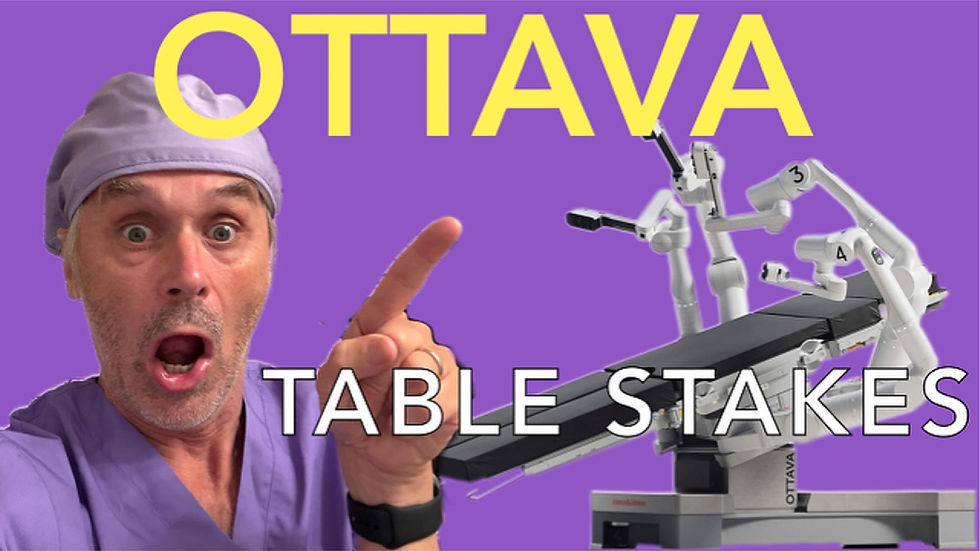
OTTAVA - Fall 2026 update


The FDA granted Ottava De Novo authorisation on 21st July 2026. This was a massive moment for Johnson & Johnson (and well done to that team). But now a few months on I’m being asked - “What’s the updates fella?” I added the fella myself just to be clear.
Weeeeellllll there have actually been a lot of updates and information dripping out. I myself have done a lot of analysis on the systems (see at the bottom of the page some video links for convenience.)
Let me start with the fact FDA has dropped some (but not all) of the documents on the De Novo and we have more detailed descriptions now on how they classified the system. And a few interesting snippets from these FDA docs make some interesting reading.
FDA Classifcation of OTTAVA
Firstly this is how they classified the system:"The Center for Devices and Radiological Health (CDRH) of the Food and Drug Administration (FDA) has completed its review of your De Novo request for classification of the OTTAVA
™ Robotic Surgical System, a prescription device under 21 CFR Part 801.109 with the following indications for use:
The OTTAVA Robotic Surgical System is intended to assist in the accurate control of endoscopic Instruments, Endoscopes, and Accessories for visualization and manipulation of tissue including grasping, cutting, blunt and sharp dissection, approximation, ligation, electrosurgery, suturing, and to allow the surgical staff to reposition the patient by adjusting the Table without undocking during upper abdominal general laparoscopic surgical procedures in accordance with the representative, specific procedures set forth in the Instructions for Use. The System is indicated for adult use. It is intended to be used by trained physicians in an operating room environment.
FDA concludes that this device should be classified into Class II.
This order, therefore, classifies the OTTAVA™ Robotic Surgical System, and substantially equivalent devices of this generic type, into Class II under the generic name integrated operating table - electromechanical surgical system.
FDA identifies this generic type of device as:
Integrated operating table -electromechanical surgical system. An integrated operating table - electromechanical surgical system is a software - controlled electromechanical platform, consisting of a surgical table with integrated robotic arms and table motion capability, that enables a qualified user to perform surgical techniques during minimally invasive and laparoscopic surgical procedures. The surgical table can be used for open surgical procedures independent of the robotic platform.”
What do I glean from that about OTTAVA?
It’s an OR table that acts as a robot is how I read it. And that could raise some odd procurement debates later on. “Are we buying a robot with an operating g table - or an operating table with a robot capability?” I am going to watch how that plays out in Europe as so much of the robotics procurement gets “objected to” by competitors... and ends up in legal proceedings. And often with a judge. I have no clue how that will work in practice and not sure it would be a valid "appeal" againsty tender awards but I've seen way way way weirder legal cases in robotic tenders. One company is actually suing theor own customer at the minute. Hey!
But clearly for OTTAVA - the table IS the story for them. And even some early abstracts are indicating some user preferences related to this: During the SRS this study was presented. Small Footprint, Big Impact: Early User Experience with the OTTAVA™ Robotic Surgical System
Friday, July 24, 2026 SRS 2026
Co-Author(s):
Cory Brunton; Deanna Hertz; Carrie schmidt; Heather Benz; Dominic Papandria; Erik B. Erik B. Wilson
Purpose: Limited operating room (OR) space is a well‑documented source of workflow inefficiency in robotic ORs: cluttered rooms, restricted movement, and equipment congestion can prolong cases, reduce throughput and increase costs. The OTTAVA™ Robotic Surgical System (Johnson & Johnson) features a compact, integrated table-mounted design to optimize OR space. Following the FORTE trial (NCT06709261), we quantified surgeon and OR staff perceptions of the OTTAVA system’s user experience, with comparative evaluation against da Vinci™ systems.
Materials and Methods: An online, cross-sectional quantitative survey of surgical staff participating in the FORTE trial was administered after trial closure (March-April 2026). The sample included 28 US-based participants (13 surgeons ,15 OR staff) invited via email; eligible participants completed at least one procedure with the OTTAVA system. Respondents (surgeons, surgical first-assistants, scrub nurses/technologists, circulating nurses, and OR managers) completed qualitative interviews exploring the end-to-end procedural experience; findings informed a 15-minute, 27-item survey with 20 items on usability, workflow, ease of adoption, and ergonomics using 5-point Likert scales (1=strongly disagree to 5=strongly agree). Items comparing the OTTAVA system against da Vinci Xi and da Vinci DV5 platforms were asked of respondents who indicated proficiency with the comparative systems. Results are reported as top-two-box agreement percentages (proportion selecting 4 or 5). Statistical analysis was not performed given the descriptive nature of this convenience sample.
Results: Twenty surgical staff responded (71%;12 surgeons, 8 OR staff). Most respondents (75%) had >10 years’ experience with robotic systems, while 20% had 6-10 years and 5% had 3-5 years. The OTTAVA system’s compact footprint was the clearest differentiator: 100% agreed that the small footprint unlocks OR space or enables conversion of compact ORs to robotic suites, 95% agreed it creates workflow efficiencies, and 90% agreed it enhances OR visibility, team collaboration, and communication. Compared with da Vinci Xi, 95% agreed the OTTAVA system reduces equipment clutter and accident risk, lowers equipment collision risk (90%), simplified setup due to automated arm poses and guided workflows (80%), and makes it easier to maintain sterility and resolve sterility breaches (65%). Among respondents proficient with da Vinci 5 (n=12), perceived benefits included clutter reduction (83%), equipment collision risk reduction (92%) and ease of maintaining sterility (67%,). Adoption outcomes: 100% felt prepared and confident on the new system after professional training; 95% found the new system an easy transition from da Vinci Xi; 100% reported the software was instinctive, with an easy-to-use interface, and all OR staff found the guided workflows increased confidence during the learning curve. All surgical staff rated ergonomics superior to da Vinci Xi (42%) or equivalent (58%); with most reporting equivalency to da Vinci 5 (75%).
Conclusions: The survey shows strong, consistent positive perceptions of the OTTAVA system’s footprint, ease of adoption, and ergonomics among a small sample of experienced robotic surgeons and OR staff. The system’s favorable user perceptions and compact footprint suggest it may appeal to facilities planning a multi-robotic platform strategy or to space-constrained ORs. These hypothesis generating results warrant further research given sample size and possible recall bias.
This leans into the fact that, as I discuss in my analysis of the bed vs Intuitive video, the reduced footprint during surgery could be an attractive advantage to get robotics into ORs that previously were deemed too small for a da Vinci. And I agree - this would be a super sensible first battle ground - rather than trying to displace a DV. It also indicated simple transferability from one system to another. Of note in that study is they acknowldge that it would be part of a multi robotic system stratregy by a hospital. Of course as no one is throwing out the 2 Xis to make room for an OTTAVA. But if there is restrained capacity for procedures and the only space is a smaller OR... Bingo.
This has been echoed since the initial release in analyst calls by JNJ senior management - that noted this workspace benefit and repeated it. So it feels like they will lean heavily into this differentiating feature. And so would I - because you are not going to win on many other current features against features.
So what about “Commercial traction?” - I mean they've launched right? They should have sold 100 systems by now right? - well in some dreams.
That again has been discussed on analyst calls with Joaquin Duato / Terence Flynn remarking on a "limited release, with attention to system performance, customer experience, evidence and expanded indications."
I’ll come to that in a minute... So on expanded indications what we know is that the original indications were looked at using data from the FORTE trial (30 patients) and FDA allowed Roux-en-Y gastric bypass, concomitant hiatal hernia repair up to 5 cm, concomitant adhesiolysis. And so far the FDA says adult use only (which is normal) ...and most interesting for me (if I read those right) FDA has not asked for any post market surveillance for efficacy of the system. Just regular annual reporting on complaints handling etc. Which is good news for OTTAVA. But do note - "concomitant" is in the FORTE trial but as I understand... those concomitant procedures can be done as stand alone procedures - but if anyone has clarification then do let me know.
So where’s the next procedure expansion
it’s into Inguinal hernia (not Hiatal that’s in the FORTE study) and NOT Ventral hernia. TEMPO is about Inguinal (groin) hernia - 800K plus done in the USA and about 50% done robotic now.The TEMPO trial was announced - BUT digging in there is an interesting point - again 30 patients - and 30 day follow up. So for hernia it's seemingly safety, technical failures up to 30 days and not long term efficacy.
But this is the VERY interesting part burriedin the trial site: - The management of JNJ may have indicated it will be "some time" with an expected completion in October (as per older record) - but it looks encouraging from the clinical gov site. It seems to read it was actually completed around the 21st / 24th August. Now that is interesting: - of course they will need to get all that data boxed up - ready - cleaned and presented to FDA - 90 day review - good wind… Sol we could see first inguinal hernia indications cleared bu FDA in Q1 2027 with some luck. That's not unreasonable. Q2 latest.
The first commercial sites for OTTAVA
This is where I’ll go into some big speculation based upon what is normal industry practice. So read that through this lens. It is clear that senior management have been very wise - and have said clearly “This is limited release, customer experience, evidence and indication expansion over initial placement counts.”
So it will not be about a fast land grab. To back that up Tim Schmidt did say that material contribution will not be until the end of the decade.” - and that sounds like a decent and sensible way to go about it. In the meantime there will be bridge sites that use the system - generate data - gain experience - and get JNJ set up to know how the real world system will run as a robot and... importantly as a robotics company. And it feels like a land and expand strategy to me.
So where are the first sites? - well if they follow a normal pattern - you use your initial clinical partners as your landing sites. So that would be Orlando Health — Orlando, Florida: FORTE.
Tampa General Hospital / University of South Florida — Tampa, Florida: FORTE and TEMPO.
IU Health North Hospital — Carmel, Indiana: FORTE and TEMPO.
NYU Long Island — Mineola, New York: FORTE.
Duke Regional Hospital — Durham, North Carolina: FORTE and TEMPO.
UTHealth Houston / Memorial Hermann–Texas Medical Center — Houston, Texas: FORTE; UTHealth Houston is also listed for TEMPO.
So my guess - and it is a guess - these will form 7 of about 10 sites I expect to see operational by end of 2026. Big names that would give excellent data. And do note that in many of these sites they did the studies in ORs that “would not normally be deemed big enough for robotic surgery.” And I think that is a very important part of that strategy of "footprint" being the differentiator.
So this is my best guess as to where we will se OTTAVA being used first out side of clinical trials. And I do expect more rapid evidence generation; and don’t be surprised of the first “comparative” study coming out of one of these centres in quick succession.
Now let me stop and go back one second.
Will these be genuine “commercial sites?" That’s a question. Paying customers - no strings - no proctoring contracts? No clinical trial contracts?
Well that is to be seen. In my mind not likely - I think that will come with the next batch of 10 after these initial sites. You see, if they are sensible, they want (in their words) to ensure an amazing customer experience; and well - paying customers may not be the priority. Good solid "non clinical study” cases in a more “real world” scenario would be my bet. I think that has more value than tryiongto get a few $K for a case at this stage. Contracting - payments could... could be part of the current use agreements - but I don’t care about "pocket to pocket payments." They might be good for press releases but don't reflect commercial reality.
I care when they have their first arms length commercial contracts - because that’s the real deal. And they’d be sensible to get 10 to 20 sites rocking with the system - iron out the creases - before they attempt the genuine commercial hurdle. BUT I have been wrong before. And they do have some pretty serious commercial know how now…
Team changes as people move from da Vinci to Ottava
Of note this week is the transfer of Marcus Bland - a Long term Intuitive pro. He has announced he is transitioning to Johnson & Johnson as “President New Growth Innovation Platforms at Johnson & Johnson MedTech” - which I would put OTTAVA and MONARCH in new growth platforms. But hey maybe it's something else??? In any case, Marcus brings a wealth of knowledge of how to commercialise surgical robots - and I think it is a cute signing for JNJ. And it could signal something that I think will become a trend. I believe there is now going to be a very healthy transfer market across all three of the big companies (and many of the smaller companies will lose key players to the big companies - this has already started.)
What I will say about this, is that the robot is no longer enough. The strength of commercial operations and personnel is one of the most critical success actors. This is going to be like pro sports - and transfer seasons.
If JNJ has sense they will be paying BIG transfer fees for the best talent. Bringing in people that really know what they are doing - and people with surgical robotics experience. Suture sales teams are not the right fit unless they get massive support and training - and that will take way too long. Those transfers in will bring confidence - and they have a halo effect where other industry folk gravitate around the rock stars of robotics. I reckon we are about to see a clamour for top commerciak, robotics talent and a spike in pay offers. If any company wants to win they need to bring in the big guns. Ottava seems to be starting to d that.
Where next for OTTAVA? (All my speculation)
I continue to look at the horizon for OTTAVA and feel I know where they have to go next. In terms of procedures I see the roadmap like this: Inguinal Hernia - Ventral Hernia (tough with a table integrated system and I can go into that in another post) - Gynaecology (I’ve just seen a host of patents with colpotomy cups in them) - hysterectomy stuff. Thoracic is a must - as RATS is predominant in the USA and that means they will need to do that once they know the system is stable - doesn’t fault or block. And remember that thoracic is the gateway to cardiac…
After that they will be looking at “natural orifice” for TORS and Transanal (and in the light of Intuitive’s recent CE for transvaginal) - they will need transvaginal. Now, to do that you need to be able to set the RCM (remote centre of motion) in the air - and ohhh look at that... a set of patents just for that popped up.
Beyond that - they need to start to expand system capabilities via 510Ks. And I think they need a few things quaickly. First is an advanced energy - so I see the addition of Dualto to the tower at the same time the harmonic, plus Enseal end effectors will come onto OTTAVA.
And some blade integration patents I’ve seen today indicate it could be a fully wristed Enseal. And honestly to compete with the Curved vessel sealer extend by Intuitive (which is storming along)… it needs to be wristed.
Beyond that they must get the Ethicon 4000 adapted up for the robot - and that is now “table stakes” - I’ll never get tired of that.
Then imaging - they need white light ICG and they need (see my video on manual lap use of the table and tower) they will need a hand held scope in my mind. So expect something there.
Instruments will get more end effectors and life of instruments will increase as they get through validations and verifications - piling up data to show they can get 10 -20 -30 plus lives. The extended use program of Intuitive is setting the pace - and if the "smaller OR strartegy" extends to ASCs - then the economics around razor blades will be way more imnportant than cramped ORs. Trust me.
Then it’s a software addition play over the next 12 to18 months as they give more capability to the system. And they will need to if they are to bring to light all the features I think they have in mind.
AND in parallel they build commercial infrastructure, service capability, and that all important manufacturing capacity. The “focused slow roll out” is not just about building clinical expertise; it is about building supply chain and manufacturing - to ensure you can make 10 - then 100 and then 1000. That takes a lot of time to ensure every one rolling of the line is a clone of the last. The slow roll out - in my mind - allows this to be done right. The last thing OTTAVA needs is a back order or poor quality coming off the line. JNJ needs to do this the right way - and for my Autimn / Fall update - it feels like the team are doing it right. And senior management are setting the scene in the right way now.
So that’s my Autumn OTTAVA update for 2026 - and yes - of course I have more… But I can’t give out all the candy at once. I’ll drip some out, and of course make the video…oh and speaking of video here’s some links to check out or go back to if you never finished them or skim watched them….
These are just opinions of the author from public documents and statements and can always be wrong. They are for educational purposes only.