
Surgical Stapling in Surgical Robotics - the next frontier
- Steve Bell
- Mar 1, 2024
- 22 min read
Updated: Apr 22
Indulge me: I want to make sure you understand the following content, so I need to give some background for surgical stapling in surgical robotics:
History of surgical stapling
Types of staplers
Techniques with staplers
Why staplers are critical in laparoscopy
Which procedures staplers excel in
The stapler market
The issue with Staplers
daVinci staplers
What makes a good robotic stapler
What could Medtronic, JNJ, the others do
The impact of staplers on the robotic market
Future direction of robotic staplers
I want you to understand this or it will not make much sense when I get to the robotic staplers and the nuances of the importance of those staplers.
Introduction to surgical stapling
Surgical stapling has been a "staple" (pun intended) of advanced surgery since the 1980's (earlier if you go back to the days of the original Russian staplers.)
The modern stapling era was ushered in by Dr Mark M Ravitch - when Ethicon rejected the staplers (Sutures will be king forever) - he teamed up with Leon Hirsch - created United States Surgical Corporation - USSC - and the rest... as they say... is history.

In the years since staplers started there has been a vast advancement for surgical staplers - in terms of moving from hand loaded staples (one at a time) made of silver. To stainless steel to Tantalum to Titanium. The move to cartridges with pre-loaded staples. To the advancement to completely disposable staplers. YES original staplers were metal bodies that you loaded by hand!
The staplers then moved on to better "lower" force firing mechanisms that eventually morphed into motor driven staplers with "smarts" inside. Which sort of brings us up to modern day staplers.
Types of surgical staplers (linear, circular, end cutters)
To understand the requirements of surgical staplers on a robot - you first need to understand the types of surgical staplers that exist today (and their use cases).
Linear Staplers
The most simple stapler is known as a Linear Stapler. Because it puts in a row staples in a line. This can be a straight line - or in some cases and some models a curved line.

The stapler places two or three rows of staples. Those staples pass through the tissue - and get formed into a B shape. If you fire this stapler across a tube - it closes the tube. If you then cut the tube; one side is sealed and the other side is open. You sometimes want an open part of the tube for various reasons that I won't go into now. But if you are taking the open part of the tube out - you don't care about having it stapled shut. Linear staplers can drive a massive amount of staple force (because the drive is at 90' to the staple line.)
Great for thick and strong tissue like a bronchus.
Also just by design - if you use this type os stapler you can get very low into the pelvis to close... say a rectal stump.

The design (important for later) allows a small cross profile to get right across the rectum in a very narrow space.
(Fun fact: The Linear stapler is often called a TA Stapler. This is a name given by USSC which meant Thoraco-Abdominal)
Linear Cutter
The challenge of the linear stapler is that often you would want to staple both side of the tube and close them simultaneously. So to do that you would put rows of staples on one side of the tube - and a second row on the other side - and cut in between. This is a linear cutter (as below). And it is this that has morphed into today's robotic staplers. The key thing to think about is that you drive along the entire length of the stapler the stapler drivers - and just behind them the blade. Think about how a robot might drive it! It needs a dedicated rotational drive interface to be able to get such a long blade movement.


I won't go into it all the details now - but of course you need different staplers length and strength for different jobs. (Blue smaller and green bigger.) So you have different staple thickness , wire diameter open heights, closed heights. Plus then different staple cartridge lengths - depending on the tissue. (all colour coded by tissue needs.)
In general, Linear cutters are a stapler of choice because they can seal both sides of the tube - so bowel is cut clean with no spillage (or cancer cell seeding), blood vessels without blood leak from a specimen side.

BUT - Linear cutters also have another trick up their sleeve - which is that not only can they cut tubes (transection) they can join tubes (anastomosis / reconstruction). If you want to dig deep into this there are lots of resources about stapling techniques across the web and YouTube. But honestly - as far as I see - surgical stapling is a bit of a lost art. It's become close n fire. (And that is where the robot can do some of the magic that used to be done manually by surgeons)
(Fun fact: The original linear cutters were called GIA by USSC which means Gastro Intestinal Anastomosis)

So linear cutters are very versatile - and as they can do "staple and close" and "Reconstruct", so they became the choice for Laparoscopic surgery. It makes surgery where you can't get clamps and hands in... easier. That is why the majority of staplers used in lap surgery are lap linear cutters (or Endoscopic Linear cutters or Endo Cutters.)

So take note - because as we roll into Robotic surgical staplers - this is where the action is.
You can note on this stapler that the last few inches of the stapler is "Articulated" - the original staplers were all straight - but down in the pelvis - or crossing structures - you often need to come at an angle - so articulation is now an absolute must. Note: It is still not as good to get across the rectum in a narrow male pelvis as a linear stapler !!! So cartridge length and degrees of angulation become critical to get deep down in the pelvis. Too long and you can't turn it in the pelvis. Too short you need multiple firings to get across the rectum and end up with crossed staple lines. Jaws don't open enough - it's hard to get into position. Can't articulate enough - you can't get straight across.
Circular Stapler
This is a tube to tube stapler that allows you to rejoin tubes together such as the bowel.
It puts in a ring (or several) of staples and then cuts out the excess tissue.
I won't go deep here today but this is a critical stapler and replaces hand sew anastomosis - and the controversy is "Is a hand sewn anastomoses with a robot better?"

There are various sizes and number of staple rows but the general principle of how they are used is the same across all circular staplers. I want to highlight this stapler as "if you want to eliminate the second surgeon in a robotic procedure " this becomes a problem. Because no robot can fire one of these today. So if you need a circular stapler - someone needs to fire it.

Fun fact - The original stapler was called the EEA by USSC - which stands for End-to-End Anastomoses.
Why are surgical staplers critical in laparoscopy?
I don't want to turn this into a deep history and surgical lesson on surgical stapling (although it is a passion of mine having been selling staplers since 1990.)
But first we need to understand the criticality of staplers, and so their indispensability in laparoscopic surgery - and why that makes them a "must" for robotic surgery.
Prior to staplers / or as an alternative to staplers, a surgeon would need to use a series of "Clamps" and then sutures to either transect tissue or join tissue. In open surgery there is ample space through the big incision to get all that stuff in, and you can easily bring clamps in - so it's "possible." In lap - that is not the case. Everything needs to get down a port - and you have limited ports.
In reconstructive anastomosis - the suturing of two structures together becomes and art - and it is 100% reliant on the skill of the surgeon. Suture spacing - choice - tension etc etc.

As you can imagine, this takes time - and skill. BUT in laparoscopic surgery... it becomes very very hard, as suturing is very hard laparoscopically. Trying to hold all the tissue components together - get clamps in... Well it's borderline impossible for most. So the alternative in lap was to open the patient - bring the bowel out - sew by hand (extracorporeal) - then plop it back inside and close the patient. Which in some respects defeats the point of lap surgery vs open (but it does have some benefit as incisions can be smaller - and time of exposure of the bowel to the air is less etc.)
But in general - people decided that using an endoscopic stapler - Linear Cutter (GIA) was the best way to allow transection and anastomosis in a lap procedure. You can cut blood vessels without bleeding - lung without air leaks - bowel without faecal content spillage (or cancer cells seeding). And anyone can use them - it is less skill dependent. (For the stapling nerds I gloss over here; as yes Halstead's principals apply. Bad prep gives a bad anastomosis.)

There are also several other reasons people used staplers historically - speed - It is literally - position and fire. Reproducibility - the staple line - staple spacing - tension (almost) is always the same on the tissue.
People care about this because in published studies comparing hand sewn to stapled anastomosis - staplers are as good if not better (in Golden hands). The key is that in less skilled surgeons hands - they give way better results than a "ham fisted" sutured anastomosis. It democratizes lap anastomosis.
There are lots of problems that can occur in both transection and reconstruction such as - bleeding - bowel leaks - necrosis etc. The concept is that staplers in open surgery give equal if not better results - for all surgeons.
In laparoscopic surgery - there is no comparison - it is so hard to do a hand reconstruction in straight stick lap - most people would never attempt it.
Hey - but with the robot - and it's suturing ability - that becomes a different story for the few and the bold. It becomes an enabler for those that wish to attempt hand sew anastomoses in the abdomen- (but that's for another day.)
So the conclusion is that in laparoscopic surgery, staplers are an essential part of the armamentarium of any laparoscopic surgeon.
Where do staplers really excel ?
Staplers (of course) can be used in nearly all areas of surgery. But in some areas they have become almost indispensable.
Thoracic Surgery (Video Assisted Thorascopic Surgery VATS)
Although not the biggest procedure numbers in surgery - it is one area with the highest penetration of staplers by specialty. Basically - in. a confined space - and little room to manoeuvre between the ribs - suturing and placing clamps in thorascopic surgery is just not practical. And if you get the clamp wrong or suturing wrong doing that manually - the patient can bleed out in minutes.

With the need to close massive arteries and veins - bronchial structures and seal lung fissures and lung tissue - and it becomes clear how staplers with their one pass cut and seal action are a massive enabler for much of thoracic surgery.
Bariatric Surgery
When the surgeon needs to reduce the stomach volume - they often need to fashion a tube out of the stomach. This is a long distance to try and clamp and suture (in open cases). It is often in obese patients where access is difficult - and most often now done as laparoscopic (wound healing, access, speed) and many other reasons that it is favourable to do a lap approach. To do that much stomach resection, the only sensible thing is a stapler. Multiple quick firings to get a well sealed stomach tube. It's a lot of stapling and it is lucrative.

Colorectal laparoscopic Surgery
There is an abundance of uses of staplers in colorectal surgery. Lots of transections - lots of reconstruction - and the thing to do this with dirty bowel contents and cancer cells - you want seal and cut in one action where possible. These are big heavy organs that require massive amounts of skill to do manual transection with clamp and reconstruction by hand anastomosis. Way too much for most surgeons - even with a dextrous robot.
But the real need of the stapler is in the closing of the rectal stump in a low anterior resection. Here the linear cutter and articulated linear cutter becomes critical. Space is tight (especially in a male) and it would be near impossible to get clamps across and suture. So the default is an articulated linear cutter (GIA).
Gynaecological Laparoscopy
Controversial in some countries on the basis of costs. Many surgeons will used advanced energy of even bipolar energy to take the lateral edges of the uterus - and even the Uterine arteries.
Where as in many other healthcare systems (where time really is money) you can justify the use of endo cutters as time saving = money saving.

In some areas of the world - the ability to use stapling is a must. Especially where speed, turnover, reducing senior assistants is critical.
The global stapler market
So from the above we can see that in these four areas alone stapling is a massive business. It is a highly profitable business, and it has been (until recently) a highly patented business. So protected by IP.
This is over a $6 billion value market and growing.
The two leaders in surgical stapling have been Medtronic (former Covidien, Former TYCO, former USSC) and Johnson & Johnson through it's Ethicon / Ethicon Endo franchise.
These two companies have dominated by size, and by continuous innovation and clinical data.
But in the last decade as patents have expired, Chinese cheap staplers (it's actually from all over the world but this is the bucket they get lumped into) have taken more and more of this lucrative market. It has pushed it to a commodity market.
The innovation answer by JNJ and Medtronic has been creating many more nuanced stapler cartridges - lengths and heights. Adding smart electronic drive handles that regulate staple formation and transection to improve the staple lines. Improved metallurgy of the staples to make them deform less, improved anvils and staple configurations - and a host of tweaks to keep them ahead of the competition.
But slowly the market has been commoditised - and the market share of the two giants has been eroded.
But the biggest attack on this market in recent years has been the Sureform stapler attached to the daVinci robot. As that product has improved - as the range has expanded - slowly but surely it has become the third most used stapler in the market - and it soon threatens to be a number 2 or even the number 1 player. 22% procedure growth year on year is a big big hit to both JNJ and Medtronic.
That is my mind is a key driver for both JNJ and Medtronic to go racing full steam to the robotics market. It is a defence play for stapling and advanced energy.
At this rate of loss of market share - the risk becomes that this critical profit cow for both companies slips away, and could potentially put those divisions in serious trouble. (the numbers will tell us)

This graph is showing at best a stagnation in medical surgical. In real terms it is a contraction. My estimate that advanced energy and stapling play into this.
The strategy of the robot and staplers
In my mind - JNJ & Medtronic have three goals -
Stop the slide to cheap hand held staplers
Stop market share erosion by Intuitive
Gain market share against each other
1)This is one of the best things about robotics and surgical staplers. Firstly it is filled with fresh IP to stop cheap stapler companies from copying the technology. Not only that, this technology is not easy to replicate.
But the hard barrier is : the robot company decides from a technical and regulatory point of view - which stapler can get on the robot, be approved on the robot, and be controlled by the robot. The company owns the plug in the wall to the patient interface.
It's a closed system that is a total barrier to cheap "knock offs". So with some urgency, I believe, JNJ and Medtronic are working out how to get their flagship staplers onto the robot - to take care of the cheap stapler issue.
But their issue - compared to Intuitive - is they don't have a massive installed base yet - so generating the millions of procedures a year to affect that switch could take them decades.
And... "It ain't easy to get a worthwhile stapler on a robot!"
2)The rush for the robotic stapler is also to try and gain a foothold in the robotics market and therefore have their stapler used in each case. This is the only way they can stop the ever forwards march by Intuitive.
The old tactic of "they don't have data" has been blown out of the water as usage of Sureform, goes up and up. That defence no longer works. The only way to stop their relentless march is to get a stapler on a robot.
3) Second mover advantage will be a major advantage. The rate limiting step to robotic stapler adoption is not the size of your sales force, or your balance sheet - it is the size of your installed base of robots. (as of today)
Intuitive - 8000 plus
Medtronic - 100 plus
JNJ - Zero
So Medtronic should - if they get their staplers on the robot this year (maybe) - be the second runner. And they will have a few clear years until Ottava arrives - and then gets a stapler approved.... to gain market share. But if the robot is not "great" no matter if you stick a stapler on it... the worry should be Intuitive.
To get market share of JNJs staplers - Medtronic needs to eat into the competitors market - and as far as I can see - a lot of HUGO RAS so far has been into their own friendly accounts. That is great to defend their business against Intuitive - but it won't get massive gains against JNJ.
Issues with Surgical staplers
Let's not think that everything with staplers is golden. Staplers over the years have had several issues. Back in the day - they were designed for men by men - and the closure and firing force was prohibitive for a small hand - a female hand.
Thankfully the ergonomics have been a focus, and the addition of "powered firing" has almost eliminated many of those issues. On a robot there is absolutely no issue of stapler weight, size and firing force for the user. You press a foot pedal and let the computer take control. The robot arm takes the weight - and keeps that stapler rock solid during firing.
Another issue over the years has been misfires. There are many reasons from mechanical failure, to manufacturing defects , to reuse of single use staplers.
A lot of that has been eliminated by powered - smart staplers - as they are hard to reuse and will refuse to fire if too much tissue is jammed in the jaws.
The robot takes that further - and with closure force analysis, tissue thickness assessment, force to fire - all under constant measurement - the robot can inform the user and even intervene.
Articulation and visualisation. There are limits to how much you can manually articulate a stapler. Power staplers have improved articulation and made it easy with much higher angles of articulation. The robot can go even further (well Intuitive can). Because they have used every inch of capability of the drive packs to allow 120' of cone articulation.

That articulation is critical in low pelvic procedures or thoracic procedures where every degree counts.
Add to that, stable 3D visualisation - stable stapler - and the ability for the surgeon to steer the stapler with precision - then accuracy and tissue manipulation are all improved.
Surgical stapling in surgical robotics:
Early staplers on the daVinci
Staplers on the daVinci are not new. In fact Surgical stapling in surgical robotics started back with the endowrist stapler. Back in 2018 disputes over patents and manufacturing rights had Ethicon and Intuitive in a legal battle.

Back then the range was more limited - and also the movements of the stapler were slower and they had limited articulation. It was deemed expensive (compared to manual staplers of the day) and acceptance was not great as much of the surgery performed was still urology. And urologists had little use of staplers. It was thought of as a niche - expensive nice to have.
But once the general surgery and thoracic community got hold of the robot. The stapler became important. That community of surgeons love staplers - need staplers - want staplers.
Sureform staplers - the market leaders
Intuitive worked hard and developed the Sureform stapler range.

This brought a wider range of staplers - and several significant advantages in terms of control, articulation, speed, stability, precision and data feedback. I've placed below some pages from their PDF and it makes interesting comparative reading. Yes - it is their information - but it is still impressive.


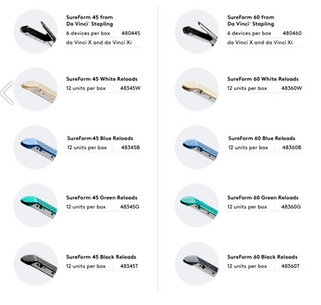


The key result was a much improved stapler came out just as the market was "looking for robotic staplers."
What also happened was that as JNJ / Medtronic tried to move the bar higher for manual staplers by adding Signia and Echelon Powered staplers - they raised the competitive price point right into the sweet spot of Intuitive.
All of these convergences have made the move to robotic staplers ripe. And the pricing can more easily be justified.
What makes a good stapler on a robot
If you ask surgeons - "What makes a good robotic stapler?" the answers go something like this.
"I need a full range of staplers and range of cartridges to accommodate all tissues"
"I need over 60 degrees of articulation"
"I need to be able to control the stapler from the console"
"I need to understand the feedback as I have no haptics"
"Cost effective compared to a manual stapler"
"Reliable performance and good clinical data"
One of the most misunderstood areas is, "the need to control the stapler from the console."
There are strong staffing reasons - in some settings a surgeon would need to pay another senior surgeon with operating rights to attend the case - unless they want to scrub in - descrub - scrub in - .descrub. And honestly if you have the option to sit and fire from the console, or do that dance - then the surgeon will opt for the control at the console. So that means all robots will need an onboard stapler if they are to remain competitive.
There is one paradox to this issue. Should the reconstruction require a circular stapler - then that (today) cannot be fired from the robot. I would imagine that the issue of low colorectal anastomosis will need to be resolved to do a "true" solo robotic surgical colorectal procedure.
What could Medtronic probably do
The drive packs of the Medtronic HUGO RAS are clearly built with enough drive units - size and mass to deal with a stapler.
Today Medtronic has a superb range of manual staplers - that are already semi smart - and capable for powered firing.


It doesn't take much imagination to understand that the Signia shaft could be adapted to the HUGO drive pack.
What would that do?
Well first it allows the tried and tested Signia staplers to be ported across - with all their data and know how. It will be a smart stapler. It will be powered articulating stapler.
So all of those benefits jump straight across.
The downside could be the speed of articulation if it remains like Signia. So they would need to improve that.

And the fact that the Signia (today) only has YAW movement and no pitch movement would be an issue for many users. People buy robots for the wrist - and if that doesn't extend to the range of staplers - it will be seen as inferior to the market leading Sureform. The advantages of porting across a manual stapler could easily be offset by lower performance.
What could JNJ do?
When Ottava arrives - I am sure Ethicon would absolutely want their staplers to be part of the product. Today they have a hand held "Robotic" stapler of sorts with the Echelon range of staplers.

The Echelon range of powered staplers again has only yaw. So of they ported this across to Ottava "as is" they may get surgeon dissatisfaction at the "wristed" inability. But they would be getting a full range of staplers, a huge stapling heritage and a huge amount of clinical data.
The Echelon is a computer controlled stapler so the port across should not be too difficult for them. What is to be seen is if they will go further and deeper and move to wristed staplers as opposed to articulating.
What will others do
So that is the main two market leaders taken care of. So they will clearly have a strategy to mount a stapler onto their hardware. That's because they do powered staplers today. And both seem to have declared they will have this "Exclusively" on their systems. That then becomes a barrier for all other robots.
So what about the Chinese daVinci clones?
Well it would seem an obvious strategy for the Chinese clones to partner with the myriad of Chinese stapler manufacturers such as Panther or others.

I would be amazed if they are not already feverishly working away to port some of the Chinese staplers across. But the IP landscape is laden with lots of barriers in this space - so I do wonder if they would ever dare to step foot out of Mainland china. To be seen.
But then you have other companies like Medicaroid, Revo, Avatera. All of this companies would need to either invent in house, or go to one of the many fledgling stapling companies that are looking for an edge. The issue with this is "time" and "credibility" plus the big challenge of full system integration. (forget tenders and market acceptance)...
Unlike JNJ and Medtronic that are steeped in stapling heritage - any new robot - with a new stapler - would have a hell of a lot to prove to convince people that it is safe and effective. In stapling - numbers count.
The next issue is volume. With a small installed base, and a lower % of those cases done with staplers - it will take decades to get to meaningful numbers for people to feel secure in using the "new comer" staplers.
This could be the big defence strategy of Intuitive, Medtronic and JNJ - and be one of the key factors that blocks off the market to all other surgical main frames.
Instead the Moon Surgical's of the world - and the Distal motions are pitched for bedside - manual procedures - so they get a free pass; allowing the user to use their tried and trusted manual staplers. This has probably been a smart move by them.
Same goes for Vicarious surgical and Virtual incision - by their design they are reliant on manual stapling - and this could be part of their undoing - as it will severely limit what can be done console side (and they are both console robots) - and this could penalise these smaller non main frames. Any procedure needing stapling will simply exclude them if the user wants to control it from the console.
And when there's a choice of 3 or more robots with staplers... the offering of the "lesser" bots may feel less appealing.
The challenges of getting a stapler on a robot (MDR / FDA)
Getting a robot on the market under MDR or deNovo is hard enough in itself. So it will be improbable that Medtronic and JNJ will try and also and get the stapler through in the same application. The logical approach would be to 510K the stapler on after clearances in the US of the actual robot. Or secondary tool submissions to MDR. But this takes time, and may again be locked down to which procedures those staplers are approved in. Damn robotics is complex.
And that is a big problem - because each day Intuitive eats more and more market share - gets more installed base. That market share eats valuable cash from the stapling divisions of JNJ and Medtronic. Cash that fuels their robot program. It's potentially a horrible vicious circle.
If you get clearance in Thoracic, Bariatric or Colorectal without a stapler - in the USA. You are going to have a very nixed system compared to the Xi.
The smart thing to do is go after Urology and Hernia - where stapling and advanced energy are not used today. Then get your stapler done as you get 510K procedure expansion.
These regulatory barriers will be a significant hurdle for any company bringing out a stapler on a robot, because it will be procedure locked for some time. And that reduces uses + strain on margins + less data to back it up - and it just gets tough.
The impact of staplers on the robotics market
Already today - tenders across the world under public procurement are written with staplers in the specifications. As Intuitive is the only supplier today that can tender for a bundled stapler offering - companies can work around it. They can say "hey that limits choice of robots!"
But as Medtronic and JNJ get staplers on their robots - the tender specifications will all be encouraged to ask for integrated stapling. It's in their interest.
That means now the three big players (that is what we could end up with) will be able to dictate tender specs with staplers - and that might be an insurmountable barrier for any other large robots. The end!
Offerings of "well our robot with manual stapling" will dry up as users insist on integrated stapling and the big companies shape tenders that way.
As we accelerate into more thoracic, general surgery, and colorectal surgery. As more lap surgeons that "love their staplers" move across to the robot. As pricing on robotic staplers tumbles closer to advanced manual staplers - staplers will become a norm in robotics. If there is a shift in site of care to the ASCs and the clinics. And a case calls for a stapler. Staffing limitations, speed and turn over will dictate a stapler is used from the console.
As the shift of laparoscopies in general surgery heads to the robot. I feel we will see the steady isolation of non stapler robots. Once Medtronic enters the fray - with their might and muscle... the market will move at lightening speed. Be prepared to see huge shifts from manual staplers to robotic staplers in the next 5 years.
Future advances in Surgical Staplers in Robotics
Although stapling has been around for some time - there are still multiple advances that can be made to surgical staplers.
One example is stapler body morphology. Today because of the limitations of trocars - any endoscopic stapler must be (by nature) straight to pass through a trocar.
Yet in open stapling - often a curved stapler body is better suited to get lower in the rectum (a surgical desire for low rectal tumours).

The issue with a curved GIA it that is cannot pass down a straight trocar. This could be overcome by using GelPorts - or another way is to make stapler bodies that can change shape from straight to curved. They could be placed through the trocar straight and then the robot could curve them. This could be well controlled when you put a stapler on the robot. Technically you could decide the shape when you're in place.
Another future area is haptics. If and when a robot comes out with successful haptics- this could be applied to staplers to "feel" the resistance to tissue compression. Or feel the resistance to blade advancement through hand controller rumble.
Staplers may get advanced blood flow sensors that would allow the user to fully understand the best place to close the robot to get maximal blood flow to the transection edge or anastomosis.
As stated - a robot controlled circular stapler would allow for low colorectal solo surgery procedures. That is a problem that needs resolving.
Combining advanced energy technology into the staplers (as has been attempted) could give better results - and minimise staple line oozing.
Finally - the removal of staples all together, as we perfect tissue welding technology could see a reduction in staples needed - or elimination of them all together. This could be very useful if trying to join tissues together with highly varying tissue thicknesses. It just also always feels better to "not leave something behind."
All fantasy for now? But it is the robot that allows a lot of these advances to potentially become reality. The drive systems - weight and complexity becomes less of an issue - the advanced imaging and sensors may already be in the next gen robots. So applying the built in smarts (including visual analytics) is part of the parcel.
Conclusions
Robotic staplers are coming faster and faster; and Intuitive is way out in the lead today with Sureform.
As more robots get staplers on the end of them... the market will surge to stapling.
"Advanced Lap surgery systems" as opposed to main frames will avoid this issue, as manual staplers will be accepted by bedside systems.
If you are a mainframe and you don't have a stapler- get one - is my advice.
These are just opinions of the author for educational purposes only. Made from speculation and general public information.
