
Intuitive's table based robot could be a threat to Ottava in the future
- Steve Bell

- Dec 16, 2025
- 10 min read

So a few weeks ago I made this video:
With my speculation about Intuitive looking into some form of ASC robot, I've explained why even a da Vinci 5 may not be the right answer for most ASCs in terms of complexity, size, cost and "over featured" for what you need. I showed a set of patents for a table mounted twin arm robot by Intuitive. And I speculated that as they have a history with Computer Motion it is not beyond the realms of possibility.
Why I'm doubling down on Intuitive working on an ASC robot
Companies do patents for many reasons... sometimes for new ideas, sometimes to strengthen ideas... and sometimes as a protective moat to stop competitors adding features to their own designs that could make them work better.
As a reminder... Ottava is a 4 arm system where the arms tuck under the bed - come out, bend up and around the bed and come over the bed to be able to operate. Bed mounted robots are not new - in fact Computer Motion had a bed mounted robot (Zeus) when they merged with Intuitive back in the early days. Intuitive is no stranger to bed mounted robots.
I strongly believe that for a surgical robot to be effective in the ASC it must have the most minimal footprint possible - and a part of that equation is solved by mounting the arms on the bed. The "zero" footprint is a bit of a fudge - as space around the bed also counts - BUT it does remove bases from the floor. It also simplifies stowage of the robot (the actual bigger issue for ASCs) by storing the arms under the bad - or... off in a cupboard.
So when I see newer patents being filed and granted - I start to think that Intuitive maybe has a bigger strategy. This recent patent filing is interesting on several fronts - and again deepens their patent estate on bed mounted system.

Yes it's from 2023 - but that is way after Johnson & Johnson disclosed their work on VERB and OTTAVA table mounted systems. And it just published now.
I will not go super technical now on this patent. But I think it is either part of a product development, or maybe just creating an IP moat around bed mounted systems (to make it more difficult for other bed mounted robots to solve some issues.) It is a pretty smart patent when I dig into it.
The challenges of bed mounted robots
There are some advantages of bed mounted robots - low foot print, automatically integrated with the table motion (hmm wait and see how that reduces to practice with patients sliding around) - arms out of the way when stowed away... And no bedside unit (s) to find a storage space for.
But like life there are always disadvantages.
One of the biggest issues of a bed mounted set of arms is the limits to how close you can get them together, and still have a working volume; and not clash (bang together.)
This has been known by the several companies that have done this before and attempted bed mounted robot arms.
One work around is in software to have clash avoidance - pre clash detection. But that still then alters some of the dynamics of the arms and creates limits. And that can become annoying to a surgeon if it doesn't let them do what they wanted to actually do.
Another way is to add an 8th Degree of Freedom to the arm - so that they can be positioned better in relationship to each other. But with that comes engineering complexity, more joints, more mass, more cost, more software etc etc. Ottava and its design patents says to me it has gone this way - I could be wrong. But by having the luxury of the total stowage of the arms under the bed - (in my opinion) it is engineering self gratification that I fear misses the potential real world impact. Just because you can... doesn't mean you should.
Not only does it potentially make the arms bigger than they need to be on a rail mounted system - more complex - more expensive. You end up with a super complex Mechatrionic robot full of PCBs (printed circuit boards) sitting in the base of the bed. That is directly under the patient and the splash zone. Great in a lab - but I do wonder how that all works when real world fluids like blood - chlorhexadine - Betadine -and more are dripping down into those mechanisms. And how does that accumulation of fluids affect the system over time? You see robot arms get somehat protected because the are draped. You can't drape the whole table and every part of every joint when it's under the table. Can you?
One advantage of a robot coming from above is that fluid runs down... not up. (okay some can track back up in rare situations) but no fluid reaches up to the Xi cross boom. When that cross boom is the table... gravity is against you.
Bed rail mounting the robot arms
Interestingly - many years ago the Auris version of the "Bake off" inside JNJ between VERB and AURIS teams (go see my patent blog here >> https://www.howtostartupinmedtech.com/post/auris-vs-jnj-1b-ruling-what-can-we-learn
On Twitter - someone from the lab posted the actual image of the system with Ashley looking at it. I have that image somewhere I'm sure. But for today I can only find my old JNJ released formal images:


So like in the Twitter image, it had a rail system (as per this patent) and the terminal end joints were seemingly hyper complex "instrument through the middle" doughnuts that clicked onto the top of the ports.
That was a super neat way of reducing arm movement above the bed - but horrendous for bringing ports close together... and the complexity of instruments through the centre of the terminal control joint... well tickle me - having dynamic tensioners for the cables etc etc. I'll maybe do a post one day as to why if I had been sitting as a strategic marketeer - I would have killed that idea before it got out of renders... (for another day.) I could have saved them a few years of work and a lot of pain.
Dear engineers - "Just because you can... doesn't mean you should!"
I digress... but what I did see at that time (about 2021) was a set of bed rails at the side of the bed (not THE bed rails that most beds have) that allowed the arms to slide up and down and position close to each other. That is not a bad idea (except for people banging their shins on them... did those engineers ever go into a real operating room - I tease ;) .... And combined with the low above the patient movement - I do understand why they thought it was a good technical idea. But I fear a terrible reduction to practical use and horrendous cost base for instruments.
I think that is why the terminal "tried and tested Z-rails" of the VERB won, and got mounted onto the final Ottava arm set up. (Still convinced it is basically two robot arms in one for each arm. A big complex payload arm that carries a slimmer lighter Z rail arm.) Woah COGS nightmare?
Oh hang on... so what if you scrap all the gubbings under the bed (gubbings is a technical term from Liverpool) - foget all the shenanigans (another technical word) - and just mount that lighter "terminal" robotic arm directly on the bed rails. No more dripping down of fluid into mechanisms. No more expensive X beams under the bed - no more complex 8DOF and all that goes with it. You could probably half the cost of the arm right there. And 1/3 of the mass.
And you could also then decide 2 - 3 - 4 - just mount these small arms as you need them onto the rail - and to be honest in an ASC you need a scope and 2 instruments for most of the day.
The big problem with my thesis
Nothing is new in robotics - as I said - bed rail mounted arms have been around a long long long time. In fact if you do a patent search... Intuitive has a load of table patents going back to before 2002. And computer motion has been doing it since the 90s.
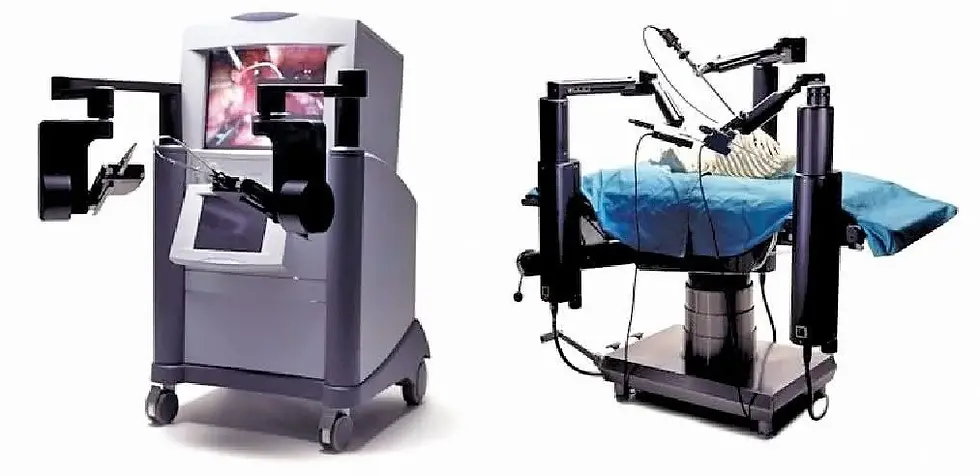
But as said before that issue of clash means you end up with challenges if you stick an arm on a fixed rail.
But those smart little devils at Intuitive might just know a thing or two about robotic arms me thinks. And what they have understood is that if you work out a sliding system but an architecture for nesting arms (bringing them super close) where they actually tuck inside each other - then you can gain those few precious centimetres of working volume without clash.
BUT - and listen up - much of the issue with ASCs is not always space in the OR it is storage space in the ASC. Well... if you now have nesting arms (the Russian doll effect) then not only would that help with peri-operative clash and proximity issues but would maybe also help with storage of the arms - size of the arms and complexity of the arms.
Why could this be devastating for Ottava or others?
I do not want to be the portent of doom here - but I feel an obligation to raise my concerns. And let's face it - these are my opinions and just opinions. What do I know?
But let me state the issues that all other bed mounted systems would face - should - if - if one day - Intuitive drop an ASC focused "Light" system with a sterile operator floating haptic console - a glasses free 3D screen on their amazing DV5 tower - and 3 to 4 arms bed rail mounted in a lightweight nested rail configuration.
Let's start with the obvious fact in the USA. Intuitive in the main operating block is so deeply established. There are now 2 da Vincis on average per main hospital in the USA. Recent Linked In posts show hospital systems buying tens of da Vincis at a time. So very quickly the "shelf space in the main block is getting full."
And no matter what people think, delude about in marketing focus groups inside the company... no one is switching to your fleet of alternative robots in the main block. Oh the big sites may get a few for reseach. But work horses day in day out? USA? That ship has sailed.
But the saving grace (in part) of Ottava is their "Zero Footprint" so that could be attractive to the sites of care like the ASC. Hmmm but up to a $2 million robot - a need to buy also the bed - a console with a footprint - hmmmmmm I'm not convinced it's enough. It's a great start and better than a DV5 for sure... but is that enough just removing the bedside boom footprint?
Enter the ASC da Vinci light?
Light weight arms that can be detached from the bed rail. You can store them in a cupboard. Add as many as you need when you need. The DV 5 tower with a 3D no glasses display and two free floating haptics that control the "just capable enough" robotic arms and instruments (probably disposable - they have the volumes and know how.)
The surgeon can do manual lap quick set up - bring in the nested arms and use just the scope (if needed) or add in a couple of robotic arms to take down the peritoneum - pop in the mesh (themselves bedside) and then suture that mesh in place with the disposable wristed needle holders. That's my dream machine... but maybe there's? All less capable than a DV5 over at the main block doing major complex cases - but a fraction of the cost per case - and absolutely capable enough for those low acuity ASC perfect robotic cases - inguinal hernia - Chole - Sacrocolpopexy - etc.
Don't need the arms for this case - just the scope? - no issue they stow away in a cupboard. Don't need the "console" no issue it stacks on the arms in the cupboard. Beacuse it's just untethered wireless controlers. And the lap tower - that just does its job as usual delivering insufflation - video - energy without the robot - as you need a tower in an ASC anyway.
Hey hey hey. This is all wild speculation !!! Don't read it as facts !!!
BUT if this emerging patent estate ever became a reality as a product - then main frames in ASCs forget it.
And lest we forget - there is a huge push to the ASC for procedures... only a foolish company would ignore that. When motivations align - patients and reimbursement follow.
What if they don't make product and it's just IP estate?
So if you think of things in a Machiavellian way - you can ask yourself what would this potentially do for other table mounted systems? Well as stated one of the main issues with bed mounted robots that engineers have to deal with is clash - and stacking the arms all on one side of the bed for certain procedures. Nesting arms is a clever way of getting around clash - so if you block up all the IP room - you just keep the monkey on the back of the competition a little longer. Throwing spanners (wrenches for you Americans) into the works is a well known patent strategy. Make it more difficult for a company to have a better mousetrap.
It could also be another very interesting IP strategy. Many of the older table patents are coming off patent - and these later IP filings are often ways to do continuations of patents with a twist - so that the patent protection stays alive and valid a little longer.
Intuitive - as said earlier - does have a lot of IP around table mounted systems from the Naughties. It could just be a group of engineers tasked with extending the patent moat to make life difficult for late followers? It could be just IP camping "just in case."
But for me... the pull to the ASC is way too strong. Momentum is building in this direction - competitors are focusing on the ASC. Intuitive must work out that algorithm - and although DV5 fixes it for some ASCs... it is not enough (in my mind) to make them a profitable ASC business that is wide reaching.
So I'm doubling down that they are cooking up a system - are working out different strategies - and with the calmness and thought they always show... they will suddenly drop an amazing ASC solution in one form or another. And that will immediately disrupt companies trying to find a bolt hole from the crowded ORs of the main block.
These are just thoughts and musing by the author for eduacational purposes only. Just guess work from public documents, years of struggle in the industry and a fertive imagination.

